Tampilkan postingan dengan label crime. Tampilkan semua postingan

Rabu, 27 April 2016

TV Show Review: The Night Manager (2016)

© BBC | Source: gstatic.com/images

UK, USA; 6 episodes; crime, drama, mystery, spy thriller
Channel: BBC1, AMC
Screenplay: David Farr, based on a novel by John le Carré
Cast: Tom Hiddleston, Hugh Laurie, Olivia Colman, Tom Hollander, Elizabeth Debicki, Alistair Petrie, Natasha Little, Douglas Hodge, David Harewood, Tobias Menzies, Antonio de la Torre, Adeel Akhtar, Michael Nardone

"Children grow up thinking the adult world is ordered, rational, fit for purpose. It’s crap. Becoming a man is realising that it’s all rotten. Realising how to celebrate that rottenness, that’s freedom." - Richard Roper

When putting together the schedule for this month, I was looking for a new and exciting TV show to dig my teeth into. My eyes fell on The Night Manager, a BBC miniseries based on the 1993 John le Carré novel of the same name. Both are centered on Jonathan Pine (Tom Hiddleston), a hotel night manager who signs up for an undercover operation of a joint British-American taskforce to bring down ruthless business man and arms dealer Richard Roper (Hugh Laurie). During its 6-episode lifespan, we see Pine assume multiple identities, become the lover of two beautiful women, befriend and defeat said arms dealer, and travel all over Europe and the Arab world. First broadcast in the UK on BBC1 in February to raving reviews, I figured The Night Manager must really keep what it promises. I mean an 8.4 score on imdb.com and critics gushing over the reinvention of the spy thriller don’t lie, right? Well, in this case they might have… or at least exaggerated quite a bit. Don’t get me wrong, The Night Manager isn’t terrible. It isn’t even a bad show per se. But in my opinion the miniseries just fails to live up to the hype. Yet, since it started in the U.S. last week, all I have seen are stellar reviews all over again. How can that be?
© BBC | Source: serieslyawesome.tv

As a fan of intros, this usually is my first clue as to whether a show is going to make a good first impression and set the right mood. Here we have a beautifully designed opening montage that in style, visuals, and music right on made me think: Downton Abbey – but with guns… It’s Downton Abbey meets James Bond! Awesome – love Downton, love James! So far so good.

What really is brilliant about this show is its international setting. Taking place in an affluent environment in Egypt, Switzerland, Spain, Turkey, and London you get to enjoy secluded beaches, snow-clad mountains, as well as oriental 5 star hotels. The scenery is truly beautiful and (except for the Swiss mountainside and rainy London) might as well be a travel ad for the Mediterranean. To those of us, who don’t immediately associate Mallorca with drunk and raging Brits and Germans, Richard Roper’s island home might be somewhat out of a dream world. Kudos to the location scouts none-the-less. In fact, all the sets were absolutely breathtaking and detailed. Even if they weren’t postcard-worthy (i.e. supposed to be pretty) in a particular scene, the props and coloring were always to the point of what they needed to be. So well done set design and props departments. 

Also, what could be greater for an exciting spy thriller than an international setting? Well, nothing really, but still The Night Manager tries a bit too hard here. You don’t have to include all the super spy drama hotspots except Moscow here. It is a Europa or even worldwide operation, we get it, but every single place they went to gave me an immediate association with and feeling of another movie or show: Spectre in the Swiss Alps, NCIS in the Middle East, and Ocean’s Twelve at the Mallorquian villa just to name a few.

Another job well done by the creative minds behind The Night Manager is that they stray a bit from the novel the show is based on. Admittedly, I haven’t actually read it, but I read enough about it to know that they changed the setting to the Arab Spring (the novel was published in 1993, so this uprising hadn’t taken place yet). Changing the setting to events everyone can distinctly remember and which deeply influenced the current global refugee crisis, gives The Night Manager an acute relevance. In the context of recent world affairs, the show’s storyline more or less asks for critical thinking regarding the topic of illegal arms trade and governments’ involvement in furthering the current plight of millions. In addition to the change in time, the writers changed the sex of the lead
© BBC | Source: cimg.tvgcdn.net
investigator from male Leonard Burr to the female intelligence operative Angela Burr (Olivia Colman). While law enforcement is still mostly (portrayed as) a boy’s club, this gives nice credit to current discussions in film and society about equity at the work place. In quite a statement Angela Burr is not only a woman holding down the fort of truth and justice, but a pregnant yet still strong and career-driven woman with a stay-at-home husband. 

Where it feels like the show strayed too far from the original is in plot and pacing. Again, I haven’t read the novel, but a lot of times, especially in the first two episodes, where the scene is set for the whole series, scene changes are perceived as jumps in plot. You get the distinct feeling of many pages having been axed in editing. What suffers most from this predicament are interpersonal relationships. Though you’d think that a six-hour series gives you more room for character development and interaction than a 90-minute movie, a lot of the encounters between strangers seem to come out of nowhere and then you jump to a deep and devoted relationship between characters two scenes later. This is especially the case for the first episode in which Jonathan Pine is approached by Sophie Alekan (Aure Atika), a woman-kept by shady business man Freddie Hamid (David Avery), to copy some incriminating papers. Suddenly there seems to be this immense attraction between the two of them and Pine gives up everything to get her to safety. When Sophie is murdered about 5 minutes later, it becomes the reason for Pine’s involvement in the Richard Roper case. The whole plot of The Night Manager and the main motivation of its protagonist stems from a brief encounter with a lady that, a few days before, Jonathan Pine didn’t even know. Now he’ll spend years trying to avenge her death – yeah, right. Storytelling elements like dreams, foreshadowing, and déjà vu are pretty conventional, too.

An admirable skill (yeah, right), when regarding the previous findings, is that even though a lot of plot elements and developments were rushed in the making of this series, the story is very slow to get going. It feels like nothing significant or plot-furthering happens in the first two episodes. For a spy thriller, there never really is much suspense to make you nervous and get your heart pumping. I am a bit of a fraidy-cat when it comes to crime and horror (even though I love it) and really there were only two occasions when I got slightly jumpy. One occurred in the middle of episode three when Jonathan Pine breaks into Richard Roper’s secret vault, the Citadel. That lasted about four minutes… The other occasion was in the middle of episode six, when Angela Burr sneaks into Roper’s hotel room to steal some papers from his safe. I really hoped the badass pregnant lady wouldn’t get snuffed by the enforcer Roper sent to secure his room. But really, not a lot of writers are that cruel and the whole endeavor was over in a flash. Kind of disappointing that the supposed re-inventor of the spy thriller genre turned out to not be such a thrill after all… That the grand finale basically played out as a neat 25-minute ride into the sunset for the good guys – Tom Hiddleston even got the pretty girl in the end, I mean come oooon – by then really surprised no one.

Performance wise The Night Manager has nothing to be ashamed of. Even though I still can’t really
© BBC | Source: gannett-cdn.com
decide if Tom Hiddleston got his poker face on for the entire series to save his character or if his acting is just that impassive, I choose to believe he does pull off Jonathan Pine. Although there doesn’t seem to be real depth to his performance, it is nice to see Hiddleston’s face for once. Hugh Laurie plays Richard Roper (what a brilliant sounding character name, come on!), ruthless arms dealer, lover, and father. As per usual, I was amazed that Laurie’s seemingly stiff Britishness allows him to play all range of emotions from gentle and loving to ruthless and scary, even if there is always a certain reserved-ness in his portrayal. Plus, whoever can pull off lines like “War’s a spectator sport,” or “Nothing is quite as pretty as napalm at night,” deserves some recognition. 

The two female leads, however, are the ones who really know how to use the stage they are given. Olivia Colman portrays pregnant operative Angela Burr in a remarkably hands-on way. She isn’t overly dramatic. She doesn’t have to constantly stress her status as being pregnant, in fact she seems to ignore it most of the time or uses it as a “perfect disguise”. The only time Burr reverts from her “let’s just get the job done” attitude, is when she is almost caught in Roper’s room by his bodyguard. She breaks down in the elevator and we get to see, that Coleman really has a feeling for the character she is portraying. In this instance, her performance is positively rattled. Yet, her character is stone cold and determined, no matter the cost, when pressured by corrupt higher-ups. Elizabeth Debicki plays Jed Marshall, the young and beautiful lover of Richard Roper. She brings a woman to life that is very free in showing her body, while closing off her mind and heart. Debicki endows her character with an air of mystery that leaves the viewer wondering who Jed really is. When we find out she is keeping secrets and possibly even spying on her lover, Jed just gets all the more intriguing. Seemingly frail and emotional, there is still an inner strength and determination to her, that makes her risk her life for a good cause and withstand torture.

Overall BBC’s The Night Manager is a decent enough spy drama that, if you don’t have to watch it in one sitting, can be an almost pleasant pastime. Still, I believe a movie (or different writers) might have been the better option to ensure a fast-paced thriller. The basic idea of the story is intriguing and the show does a good job of relating back to our reality with its real problems, yet the spark of excitement never really catches on. The cast, on the other hand, is great and, if it wasn’t for the lack of developed personal relationships, I am sure they’d have been able to benefit from and play with each other nicely. The star of the show, however, is by far the scenery. The beautiful travelling shots over snow-capped mountains and blue Mediterranean lagoons are almost enough to justify sitting through six hours of spy blabbing – or at least enough inspiration to make you pick up your phone and look up travel destinations for your next vacation.

Rating:

Kamis, 21 April 2016

Film Review: Taxi Driver (1976)

© Columbia TriStar | Source: Cinema Jam

USA; 113 min.; drama, crime
Director: Martin Scorsese
Writing: Paul Schrader
Cinematography: Michael Chapman
Cast: Robert De Niro, Jodie Foster, Harvey Keitel, Cybill Shepherd, Albert Brooks, Peter Boyle, Leonard Harris

“I think someone should just take this city and just... just flush it down the fuckin' toilet.” – Travis Bickle

It’s time for the Tribeca Film Festival, y’all, and quite a few exciting new films and TV projects have been shown over the last days. Katie Holmes premiered her feature film debut All We Had last Friday, upcoming Thor: Ragnarok director Taika Waititi showcased his New Zealand indie flick Hunt for the Wilderpeople yesterday, and Tom Hiddleston is there to talk both his work on the dystopian thriller High Rise and the BBC series The Night Manager. There are many more topical things going on at the New-York-based festival, of course. However, this post is all about nostalgia.

Today marks the 40th anniversary of Martin Scorsese’s cult classic Taxi Driver. Its star, Robert De Niro – one of the two founding members of the Tribeca Film Festival –, decided to hold a special screening of the film tonight. Afterwards, Scorsese, producer Michael Phillips, writer Paul Schrader, De Niro and his co-stars Jodie Foster and Cybill Shepherd will join in to discuss the film and pay tribute to its significant role in movie history.

Since, sadly, the BSP team cannot be in the Big Apple to witness this memorable occasion live and in colour, I still don’t want to miss out on letting you in on my own personal experiences with Taxi Driver: to be completely honest, until yesterday, I really didn’t have any. While I wait for you cinephiles out there to leave your state of shock, let me tell you that I actually took the movie’s anniversary celebration as an opportunity to close the glaring hole in my cinematic knowledge. After all these years of ignorance, I was finally ready to be blown away by a film that, in 1994, the Library of Congress selected for preservation in the National Film Registry. A film that won the Palme d’Or in Cannes and is among the one hundred best films of all time chosen by Time.

Suffice it to say that Taxi Driver is critically acclaimed, highly regarded, universally admired and, basically, the wet dream of anybody in love with moving pictures. Anything other than a full five-star rating is considered blasphemy, and every person who is brave enough to actually voice their criticism of the film simultaneously feels the need to apologise for doing so. Taxi Driver is one of those movies that has people believe that film criticism is utterly objective and that you either ‘get it’, thus demonstrating that you are a true and dignified film connoisseur of the highest order, or that you don’t ‘get it’, which has you end up with the reputation of a lowbrow simpleton with a thorough love for Michael Bay flicks. I, however, do not intend to apologise for saying that Taxi Driver left me underwhelmed in some respects.

Following the psychological breakdown of Vietnam veteran Travis Bickle (Robert De Niro), Scorsese’s fifth feature film ambitiously tries to portray the deterioration of New York city life, interpersonal connections and, well, society as a whole. Trapped in a world that doesn’t understand and value him, Travis is looking to leave his mark. He wants to be acknowledged, respected and loved, but instead is judged, ignored and belittled – until his diseased mind and paranoia have him take drastic measures.

The premise is fascinating and, after 40 years, still resonates with our own reality in a frightening way and manner. Travis is a man without the ability to connect with others. He becomes emotionally numb and selfish, and is on the brink of vigilante violence. He finds empowerment in weapons and in the fear he induces in others. The fact that, in all his insanity, he seems to follow a certain moral code, a plan with which he intends to rid the city of its seedy underworld elements, gives him an endearing complexity. Back then, a society shaken by the effects of the Vietnam War could probably relate to his lack of empathy, his numbness in the face of brutality, his longing for heroic action. Today, in the world of Columbine, Norway, Aurora, Afghanistan, Paris or Brussels, we find ourselves confronted with self-righteous vigilance every day. 

Taxi Driver is solely about Travis’ mind. There is no conventional storyline to follow. The film much more explores his psyche and how he perceives his surroundings. Michael Chapman’s masterful cinematography captures a gritty, sinister picture of New York, with dark allies populated by prostitutes, pimps, punters and porn cinemas. Here, New York is a place of crime and exploitation, a place in which whoremongers such as Sport (Harvey Keitel) lure in young women such as Iris (Jodie Foster) to sell their every orifice for a few bucks. Hope seems to be long gone, and even the city’s presidential candidate Charles Palantine (Leonard Harris) appears to be more showmanship than substance. There’s a constant atmosphere of unease as well as a very postmodern juxtaposition of beautifully arranged cinematographic images and the rotten things they actually portray. Furthermore, the on-point editing and sound editing help to establish Travis’ incoherent mind.

De Niro – long before he agreed to do Dirty Grandpa and Meet the Fockers – shows why he is considered one of the greatest actors of all time. His Travis is upsetting, unsettling and utterly unlikeable. He is filled with self-loathing and self-destructive tendencies. He’s mad as hell and yet passes for an inconspicuous everyday person. It is this Average Joe quality, which De Niro brings to the role, that makes Travis truly creepy, reminding me of Anthony Perkins’ portrayal of Norman Bates in Psycho. It is under the surface where a person’s soul plunges into the darkest abysses.  

For a film, however, that is crafted so beautifully and acted so dedicatedly by its main actor, I can’t help but wonder why Taxi Driver left me so cold. Travis certainly is an intriguing psychological case study – but I guess there’s something about Scorsese’s approach that is just too clinical, too sterile for me to truly become invested. There are no relatable or likeable characters, everything and everybody is filtered through Travis’ unhinged mind. His crush Betsy (Cybill Shepherd) is first an angel and then a stuck-up bitch in his eyes. Palantine is first an ally and then a disappointment. Iris is a woman in need of salvation and remains so till the very end. All characters besides Travis are pretty dull and flat. Instead of enjoying this lack of an emotional, relatable anchor as a device to demonstrate Travis’ one-sided world view, I find it rather tedious after a while. In the end, Travis’ deterioration is well thought through in theory but, as an actual cinematic experience, doesn’t manage to hit me in the stomach and make me feel the frightening consequences of his fall into emotional coarseness.

Anyway, Taxi Driver has undoubtedly influenced cinema. It still serves as a shining example of films that feature antagonists in the lead, that use the contradiction of aesthetic pictures vs. ugly subject matter, that rely on depicting psychological mechanisms through imagery rather than on telling a conventional, straightforward story. I applaud Taxi Driver for the mark it has left in movie history and I congratulate it wholeheartedly to its 40th anniversary today. However, I won’t shy away from saying that there is a subjective component to every movie experience. Whatever makes your emotions, your enthusiasm overflow can fail to move somebody else. Taxi Driver doesn’t move me. I find it wanting. I have no shame. You want to question me? Oh yeah? You talkin' to me?


Rating:  

Senin, 16 November 2015

Manic Monday: Chicago Week Opener

© Miramax | Source: YouTube screenshot
Today's Monday isn't a usual Manic Monday. Over here at BSP, it's the beginning of a Chicago-themed week filled with exciting content all around the Windy City. For you, this means that in the upcoming seven days, you should keep checking our site and social media presences to not miss out on the fun.

Why Chicago Week, you might wonder? Our response to this would be, well, why not? In fact, we got inspired because our very on Squuls happened to be on location last week. She has some goodies in store for you in the next days. Additionally, our Nata Lie has taken a closer look at Chicago's connection with one of the most popular comic book cities out there. Which one? You're sure to find out soon. Until then, there's even more Chicago glory to come.

Today, I'm gonna kick off our thematic week by presenting you with a classic scene (in two parts, alas) from the 2002 musical movie Chicago. Set in the Prohibition era of the 1920s, the film evokes a time in which mobsters such as Johnny Torrio and Al Capone shaped the notorious criminal history of the city. And while we always tend to associate Chicagoan crime with a bunch of male players, Rob Marshall's film shows us that it's the ladies who know all about ruthless revenge.

Enjoy the scene, and have a great time visiting Chicago with us.


Rabu, 11 November 2015

Film Review: The Drop (2014)

© 20th Century Fox | Source: The Artery
USA; 106 min.; crime, drama, neo-noir
Director: Michaël R. Roskam
Writing: Dennis Lehane, after his short story “Animal Rescue”
Cinematography: Nicolas Karakatsanis
Cast: Tom Hardy, Noomi Rapace, James Gandolfini, Matthias Schoenaerts, John Ortiz, Elizabeth Rodriguez, Michael Aronov, Morgan Spector, Ann Dowd, Michael Esper, James Frecheville

“That is life. That's what it is. People like me coming along when you're not looking.”  -- Eric Deeds

There are many films out there showing a heist gone wrong, but only few manage to deliver such a fresh and unique feeling like Michaël R. Roskam’s The Drop. Based on a short story by crime aficionado Dennis Lehane – writer of novels such as Mystic River, Gone Baby Gone or Shutter Island – this film is a neo-noir gem in which genres like crime thriller, family drama and rom com unite with ease.

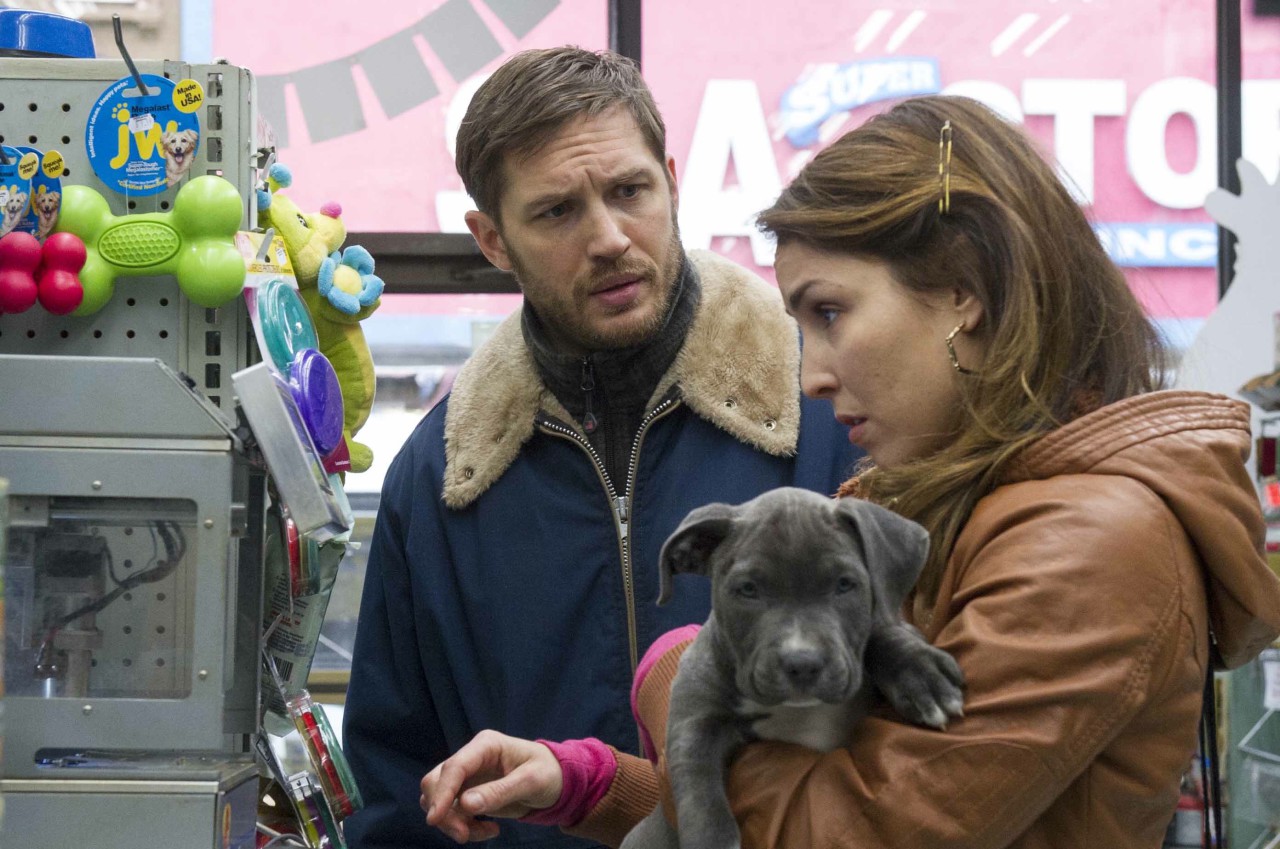
The story is unfolded in three narrative threads: There are Bob (Tom Hardy) and his cousin Marv (James Gandolfini) who run a bar belonging to the Chechen mob. When, one night, the bar is robbed by two masked men, Bob and Marv are under pressure to retrieve the money. Then there’s Nadia (Noomi Rapace) in whose waste bin Bob finds a hurt pit bull puppy. Nadia and Bob befriend each other while taking care of the dog, and soon find themselves up against Eric Deeds (Matthias Schoenaerts), a known psychopath and owner of the puppy he now wants back. And, finally, there’s Detective Torres (John Ortiz) who investigates not only the bar robbery but also the disappearance of a young man who is said to have been murdered by Deeds almost ten years ago.

The outline seems to indicate that we’re directly headed into 106 minutes of full-on mobster bloodshed and insanity. However, actual violence is not at the centre of The Drop. There are, of course, moments of brutality – but they’re short and only mildly graphic. Roskam’s film relies much more on character development and a thick, intense atmosphere – and this is where the genre mix takes its full effect. Setting Bob’s sweet, blossoming relationship with Nadia and his growing affection for the little puppy up against his Chechen trouble and the sadistic Eric Deeds causes a fair amount of unease. People who have the tendency to fear for the pet whenever they watch a horror movie or thriller – like me – will probably remain on the edge of their seats throughout most of the film. But even without the cute puppy in distress at the centre of things, The Drop succeeds in portraying how sweetness and decency are corrupted in a world ruled by power struggles, revenge and sheer madness.

For me, Bob certainly is one of the most intriguing cinematic characters in recent years, and Tom Hardy plays him to perfection. As the butt of the film’s inherent dog metaphor, Bob functions as the human counterpart to the little combat dog: he’s sweet-natured, open-minded, unassuming and protective of the ones he holds dear. And yet there’s something unsettling about him when we see how naturally he navigates through the challenges his crime-ridden neighbourhood throws at him, how easy it is for him to adapt to his surroundings. Hardy gives the character quirky features without ridiculing him, an innate strength without turning him into an alpha male and a sadness without having him appear whiney. His Bob is an intriguing, subtle take on the lonesome noir hero figure.

The film features a splendid cast in general. Noomi Rapace delivers a heartfelt performance as a woman who has pulled herself out of emotional misery, and has wonderful chemistry with Hardy. The late James Gandolfini, in his final performance, plays his established ruthless gangster role, but his present discontent and longing for better days gone by give him a human twist. Matthias Schoenaerts certainly is an actor to look out for. He gives Eric a good amount of unpredictability and makes him instantly menacing. John Ortiz as the persistent cop is solid, even though his plot appears a bit like mere filler material until things come full circle in the finale.

Those who are familiar with Lehane’s oeuvre know that the writer enjoys a good twist. The Drop also succeeds in connecting all the loose threads to a rather unexpected revelation. If I would have to come up with some kind of beef I could have with the film, though, it’s probably that things aren’t as effective on a second viewing. The moment I knew when and in what way tensions were going to relieve themselves, the atmosphere was no longer as haunting as it was during my first viewing experience and, naturally, the twist no longer comes unexpectedly.

Still, it pays off to (re)visit The Drop since it’s not only about plot development or grand twists at the end. The film presents us with thoroughly written and acted characters, and it’s fun to see them form and deconstruct their mutual relationships. Additionally, there’s an intriguing layer of social criticism as well as an exciting exploration of human nature. Throw in an unconventional yet fitting mix of generic tones and a cute puppy, and you’re certain to have created a crime drama that definitely shouldn’t be dropped.


Rating: 

Rabu, 23 September 2015

Data Base: Sons of Anarchy

© FX | Source: TheLowDownunder

Series Premiere3 September 2008
Series Finale9 December 2014
Genrecrime, gangster, drama
Country of OriginUSA
No. of seasons7
No. of episodes92
Running Time40-80 minutes
ChannelFX
Website---
Developed byKurt Sutter
StarringMark Boone Junior, Dayton Callie, Kim Coates, Drea de Matteo, Tommy Flanagan, Charlie Hunnam, Ryan Hurst, David Labrava, William Lucking, Michael Ornstein, Ron Perlman, Theo Rossi, Katey Sagal, Maggie Siff, Jimmy Smits, Winter Ave Zoli 
Guest Stars Worth MentioningSamaire Armstrong, Michael Chiklis, Rockmond Dunbar, Walton Goggins, David Hasselhoff, Hal Holbrook, Kenny Johnson, Jay Karnes, Q'orianka Kilcher, Courtney Love, Marilyn Manson, Lea Michele, Harold Perrineau, CCH Pounder, Mathew St. Patrick, Ashley Tisdale, Danny Trejo


Synopsis
Jackson 'Jax' Teller (Charlie Hunnam) tries to come to terms with the love for his former high-school sweetheart Tara (Maggie Siff), his domineering mother Gemma (Katey Sagal) and the toils and troubles of his criminal motorcycle club, the Sons of Anarchy.


Yay or Nay?
Definitely a Yay! for fans of crime and ganster stories but also recommended to everybody who enjoys some good old family drama. SoA offers a bunch of likeable anti-heros, thrilling storylines, humour, great acting and a rather impressive/fun list of guest of stars. So, hop on your bike and join the gang!

Rabu, 02 September 2015

Data Base: Hawaii Five-0 (2010 - )

©superbwallpapers.com | CBS
Series Premiere20 September 2010

Genreaction, crime, drama
Country of OriginUSA
No. of seasons5
No. of episodes118
Running Time42 min.
ChannelCBS
Websitehttp://www.cbs.com/shows/hawaii_five_0/
Developed by Leonard Freeman, Alex Kurtzman, Peter M. Lenkov, Roberto Orci
StarringAlex O'Loughlin, Scott Caan, Daniel Dae Kim, Grace Park, Masi Oka, Taylor Wily, Michelle Borth
Guest Stars Worth MentioningJorge Garcia, Terry O'Quinn, Autumn Reeser, William Baldwin, Nick Jonas, Mark Dacascos, Will Yun Lee

Synopsis:

This action-police-procedual drama is the remake of the 1968-1980 television series of the same name. Set in tropical Hawaii the show revolves around a special police task force led by former Navi Seal Steve McGarret and his very east coast partner Danny Williams. Chin Ho Kelly, a reinstated police officer, and Kono Kalakaua his newbie cousin. Extreme cases involving drugs or terrorism alternate with more personal cases like the conspiracy behind the deaths of McGarret's parents. In the end it is not only the job, but friendship and loyalty that connect the team.

Yay or Nay?

While Hawaii Five-0 deals with serious cases, there's also a lot of comedy involved here: be it the banter between Danny and Steve or the lunch breaks at Kamekona's shrimp truck, there's never a dull moment in this task force. Compelling background stories of the characters and the fantastic landscapes of Hawaii round off the picture. As a bonus Lost fans can be sure to see one or the other familiar face popping in for a visit.

Rabu, 26 Agustus 2015

Data Base: White Collar (2009 - 2014)

©Exclusive Suit 4 you | USA Network
 Series Premiere23 October 2009
Series Finale18 December 2014
Genrecomedy, crime, drama
Country of OriginUSA
No. of seasons6
No. of episodes81
Running Time42 min.
ChannelUSA Network
Websitehttp://www.usanetwork.com/whitecollar
Developed byJeff Eastin
Starring
Matt Bomer, Tim DeKay, Willie Garson, Tiffani Thiessen, Sharif Atkins, Marsha Thomason
Guest Stars Worth MentioningHilarie Burton, Alexandra Daddario, Joe Manganiello, Treat Williams

Synopsis:

In White Collar Neil Caffrey, a smooth and sexy art forgerer and con-artist, is caught by FBI  special agent Peter Burke after a seven year chase. Charming and skilled as he is, Caffrey is able to negotiate a deal where he helps Burke and his team in the NYC White Collar division in exchance for his freedom. Even though Neil is given an ankle bracelet to secure his whereabouts at all times, he never quite loses his former ways. Still, in Peter Burke he finds a mentor and more importantly a true friend.

Yay or Nay?

While (on paper) this looks like yet another crime show, White Collar is so much more. Of course there is the weekly case that (most of the time) Neil has to help on officially, while secretly trying to score the goods for himself. This is a show about a trickster, which in it's setup has a lot of comic potential as well. It's a breath of fresh air compared to those other dark and gloomy crime shows out there, as there seldomly are life and death situations and the show doesn't take itself all that seriously. White Collar is also a show about relationships and unlikely friendships. Loyalty and kindness are two qualities that are very important to the characters and the criminals of the main cast are more of a gentleman thief than anything else. Fans of whitty dialogues will find what they are looking for here and the dynamic between the cast members is something to enjoy as well. Fancy costumes and great shots of NYC complete the picture. Definitely give this one a go :)


Rabu, 22 Juli 2015

Trailer Check: Southpaw (2015)

© The Weinstein Company | Source: YouTube screencap

southpaw /ˈsaʊθpɔː/ 
  A left-handed boxer who leads with the right hand


I'm a sucker for sports movies, especially those about boxing. Raging Bull, Rocky, Warrior, The Fighter - you name it, I've watched it. So, naturally, I'm beyond excited for the release of Antoine Fuqua's latest feature in two days time. And if I choose to go by the most recent trailer alone, Southpaw is certainly bound to impress.


There seems to be a familiar formula at hand here. Like every self-respecting boxing movie, Southpaw needs a washed-up boxer at its centre who, against all odds, has to use the power of his mind and fists to regain his dignity. In this case, Billy Hope (Jake Gyllenhaal) loses control over his life and sporting career after the tragic death of his beloved wife Maureen (Rachel McAdams). In order to get back on track and, most importantly, win back the custody for his young daughter Leila (Oona Laurence), he teams up with boxing coach Tick (Forest Whitaker), the obligatory good soul of the story, and promoter Jordan Mains (Curtis '50 Cent' Jackson).Yes, when it comes to plot, Southpaw fulfils all the requirements necessary to satisfy fans of the genre. 

The look conveyed in the trailer further recommends the film as a rather down-to-earth summer movie far from all the superhero and dinosaur fare going on this year. Instead of with CGI ecstasy and ambitions of world domination, Southpaw presents us with a quite unusual topic for a blockbuster of the hot season: a raw human interest story. Fittingly, Training Day director Fuqua has created a gritty atmosphere, using a washed-out colour scheme and occasional depictions of violent outbursts. Billy's hardship is present in every second of the trailer. 

The script penned by The Shield producer and Sons of Anarchy creator Kurt Sutter also adds a certain gangster flair to the story by depicting Maureen as a victim of two rivalling sporting camps, and Billy as a desperate husband out for revenge. This contributes to the general feeling of mayhem and unease palpable in the two-minute preview as well. It only remains to be seen if the film will eventually be able to effectively unite the genres of sports drama, underdog tale and crime thriller, which it evokes in the trailer.

It might still be slightly early to start off award season, but Gyllenhaal certainly looks like he's about to put a foot in the door to the upcoming Oscar race. The trailer suggests a physical and emotional tour de force by the 34-year-old actor. I personally cannot wait to see his character travel from self-loathing to self-esteem. And with the likes of Whitaker and McAdams as support, the rest of the cast isn't meant to disappoint either.

Despite a rather gloomy preface, the trailer ensures that there'll also be a goosebump-inducing, spirit-raising finale at the end - as there should be. With the song "Kings Never Die" by Eminem and Gwen Stefani playing in the background, there's no doubt that, eventually, Southpaw is all about the underdog making it out of a personal crisis. Like most of its successful boxing predecessors, it seems to make use of the feel-good factor, allowing audiences to leave the cinema in an uplifting, nothing's-impossible kind of spirit.

Southpaw's uppercut may come unexpectedly, but it definitely has all the potential to throw a wicked punch towards critical praise and box office glory. Let's get ready to rumble!


Release: 24 July 2015
Website  |  Facebook  |  Twitter  |  Instagram

Minggu, 05 Juli 2015

TV Show Review: Fargo Season 1 (2014) [Spoilers]

© FX | Source: CurrentDigitalMag

USA; 10 episodes; crime, drama
Channel: FX
Creator: Noah Hawley
Cast: Billy Bob Thornton, Allison Tolman, Colin Hanks, Martin Freeman, Bob Odenkirk, Adam Goldberg, Russell Harvard, Oliver Platt, Glenn Howerton, Jordan Peele, Keegan-Michael Key, Joey King, Keith Carradine, Kate Walsh, Rachel Blanchard, Joshua Close, Julie Ann Emery, Susan Park, Kelly Holden Bashar 
“Did you know the human eye can see more shades of green than any other colour? When you figure out the answer to my question, then you’ll have the answer to yours.”  – Lorne Malvo

Emmys, Golden Globes, critical acclaim and universal praise – Fargo's got it all. The first season of the FX series seems to have convinced everybody and their grandmother. Something underneath the frosty, greyish, snow-laden Minnesotan setting has warmed the hearts of many viewers. The sketchy, philosophical dialogues and riddles seem to have everybody in a guessing mood and Billy Bob Thornton's portrayal of a devilish hired gun the world in awe. As a consequence, I was basically ready to be stunned by Fargo – blown away, thoroughly entertained, left with an exhilarant feeling like I'd just won the Salesman of the Year award. All I felt, however, was relief. Relief that, after ten episodes of Fargo, I could finally move on and dedicate my time to something worthwhile. Binge-watching Secret Diary of a Call Girl, for example. And, yes, I really just said that.

But back to Fargo. The pilot with the sounding name "The Crocodile's Dilemma" starts off quite nicely. As the title suggests, the show already sticks deep in philosophical subtext, just to show that it knows its paradoxes, I guess. But, well, whatever. Here's what's going on: Lester Nygaard (Michael Freeman) is a mousy and unsuccessful insurance salesman with a bossy and constantly complaining wife (Kelly Holden Bashar). After being bullied and punched in the nose by an old acquaintance, Lester meets a crocodile, uh, man named Lorne Malvo (Billy Bob Thornton) at the hospital who offers to kill the bully. Since Lester does neither accept nor deny the offer, Malvo, who happens to be a professional killer, goes on to murder Lester's tantaliser. After the first shock wears off, Lester, in a heated argument with his wife, feels powerful for the very first time and kills her by hitting her on the head with a hammer. This brings in Chief Vern Thurman (Shawn Doyle) and Police Deputy Molly Solverson (Allison Tolman), and forces Lester to go to considerable length to hide his own crime as well as his connection with Malvo.


© FX | Source: Fargo Wikia

If all this sounds kind of familiar, it's because it is. Fargo is loosely based on the 1996 film of the same title by Joel and Ethan Coen; a 98-minutes feature I hold very dear for its quirkiness and absurdities, its atmospheric setting, exaggerated characters and kick-ass female heroine. Since the TV version features the Coen brothers as producers, I really hoped that the Coen spirit would automatically flow into the project as well.

And, as I said, the very first episode is nice. It manages to capture the hazy, melancholic aesthetics of the source material, with a wintery landscape that is certain to make Jon Snow feel comfortably at home. With Bemidji, Minnesota as a main setting, it also conveys an element of small town flair, similar to the Brainerd-set movie. Additionally, it tries to give some new spins to the original. For example, Lester, reminiscent of William H. Macy's good-for-nothing car salesman Jerry Lundegaard, is endowed with more criminal and deceitful potential than his movie counterpart. I also enjoy how Molly Solverson, the equivalent to Frances McDormand's bad-ass Marge Gunderson, only becomes the main police officer pursuing the Lester case after an unexpected twist of events brings about the death of Chief Thurman. The pilot cleverly plays with the expectations of those who know the film, and this is all fair and well. Nothing groundbreaking or utterly spectacular, but a sweet set-up after all.

And then it all goes downhill from there. While the series is capable of maintaining the arresting optics, it severely lacks in tone. It's way too tame to truly embrace the satirical or absurd greatness of the film, yet it's also too weird to work as a traditional crime story. Scenes like Malvo being offered to buy a pink police scanner are occasionally thrown into the usual murder mayhem. Like show creator Noah Hawley wants to assure his viewership that, yes, we're definitely dealing with a black comedy here. Some might like to scream in my face: "But why does everything have to be labelled appropriately? Can't we appreciate the multidimensional aspects of the show?" No, we cannot. I cannot. Fargo, the series, seems too scared to take its humour all the way, to fully allow for absurdity, to really be wickedly funny amidst all the serious bloodshed. Rather than complex, it feels directionless, tumbling somewhere between quirk and graveness. Just like Lester, it wants to be special, badly, but ultimately fails to withstand its time in the spotlight.
 

© FX | Source: Optigrab

I also hate how you can literally watch the show run out of steam. A case that Marge Gunderson most definitely would have solved in a 90-minute time span, drags on over ten episodes. And the creators must have known that their story just isn't rich enough to justify ten episodes. Why else plant that five-episode-long side plot surrounding supermarket tycoon Stavros Milos (Oliver Platt) into the series, when the whole things has absolutely no connection to the main plot? I mean, five episodes of seeing Milos slowly being driven into madness by Malvo – because the latter felt like it. Some call it character drawing, I call it sloppy character drawing. Seriously, if you need FIVE episodes to merely establish the mean spirit and mischievousness of one of your main characters, you should reconsider your plot outline. And then, to try and appease fans of the film with the fact that the money-filled satchel found by Milos in the episode "Eating the Blame" is the same as the one buried by Steve Buscemi's character in the movie... Come on. One tiny reference can't make up for the irrelevance of a five-episode-lasting side plot. And to waste Oliver Platt on such a storyline. Shame on you, TV Fargo.

But, no, it's not enough to fill time by establishing plots of no importance. In order to stall the investigation on the Lester case further, Hawley and his writing team rely on a bunch of beyond stupid characters. And I mean I-want-to-smash-my-head-on-a-desk-stupid; or should I say, Bob Odenkirk, anyone? In Fargo, the Better Call Saul star takes over the role of police chief after Thurman's death. Since he went to school with Lester, he absolutely cannot imagine that the inconspicuous guy should have anything to do with the murder of his wife. Even though Solverson presents him with more and more evidence demonstrating contradictions in Lester's testimony and, on top of this, his connection with Malvo, the police chief will hear no word of it. Sure. So he keeps on sabotaging Solverson's inquests until my eyes have spun out of their sockets due to all the rolling. Yet again, all this is not enough. Furthermore, two FBI agents, played by Jordan Peele and Keegan-Michael Key, chat in their car while Malvo walks into a building they're actually surveilling, shoots 22 people dead and leaves again, disguised in a group of bystanders gathered outside. While the murder spree has a nice Frenzy-Hitchcockian feel to it, the incompetence of the two agents overshadows everything.


© FX | Source: MPR News

Characters are a general problem in Fargo. Lester is utterly unlikable, as he should be, considering the things he does throughout the show. Unfortunately, he also isn't all that interesting. Once he's established himself as a spiteful, selfish little man, his act is predictable. Due to the stupidity apparently predominant in the Minnesotan law enforcement, we know that he won't get caught for a long time. Due to William H. Macey's fate in the movie, we know that his demise will certainly occur in the very last episode – and it does. The only fascinating thing left is Freeman's dedicated performance, the highlight of the series as far as acting goes.

Then there's Officer Gus Grimly (Colin Hanks), who serves as Solverson's love interest. I mean, all the people who are aware of the film know we have to get Molly pregnant somehow, don't we? Apart from his relationship with her, Grimly is rather annoying. His desperate effort to be good at his job, the little talks with his teenage daughter Greta (Joey King) – I don't care. For the most part, he really appears like an eventual sperm donor on two legs. With a firearm, unfortunately. In the episode "Buridan's Ass", in a misty pursuit, he mistakenly shoots Molly and has her end up in hospital, further stalling the investigation. Like we don't have enough silly characters boycotting the plot already...


© FX | Source: The Gonzo

Yes, appealing characters are scarce and few in this show. Molly Solverson is probably the one who manages to hold my interest at all. She still might pale in comparison to Marge Gunderson, but her heartfelt, no-bullshit style of going about things strikes a chord. Especially her scenes with her father (Keith Carradine) as well as the ones with Thurman's widow Ida (Julie Ann Emery) are lovely to watch. The fact that, in the finale, Grimly steals her thunder by killing Malvo is a huge disappointment. More shame on you, TV Fargo

Most people agree that Thornton's portrayal of Malvo is the masterpiece of the production. And, again, I don't see the appeal. I think Thornton is a wonderful actor in general and perfectly Coen-savvy, as his stint on their film The Man Who Wasn't There proves. However, in Fargo he seems like a poor copy of Javier Bardem's Anton Chigurh from another Coen film. He's supposed to be enigmatic and intense, threatening and unpredictable, yet deliciously funny at the same time. In other words, he's supposed to be the personified equivalent to the coin flip scene from No Country for Old Men. While Thornton sports a similarly terrible hair style as Bardem, his performance comes across as so subtle that it is almost ineffective. I don't sense danger and wit from him. I only sense words from a script, told with either a playful smirk or serious countenance. Besides, his character is mostly shaped through action, not through turning emotions or intentions inside out. Malvo slits a throat, so we know he's brutal. Malvo disguises as a Lutheran Minister to set the police on a wrong track, so we know he is a trickster. Malvo tries to drive Milos crazy by bringing Biblical plagues upon him, so we know he likes to play mind games. There's not much else to be had, and the act gets old fairly quickly. And then, after ten episodes of congenial criminal activity without ever getting caught, Malvo is wiped from the surface of the Earth in an anti-climactic showdown. Being shot by dimwit officer Grimly – how could one's final farewell be more irrelevant?   


© FX | Source: Huffington Post

Fargo obviously gave me a hard time. I forced myself through it, always hoping that it would improve at some point and become the show everybody claimed it was. But the truth is, I haven't been as bored and frustrated with TV since making my way through the first season of In Treatment. The plot drags, the philosophical allusions come across as clumsy attempts to bring depth to the storyline, almost all the main characters lack appeal and the stupidity of some of the supporting characters is just too much to bear. What remains is the look of the show, which is truly beautiful and captivating – but it's also a tribute to the look of the original Fargo movie. So, why should I force-feed myself ten hours of subpar storytelling, when I can watch the 98-minute source material featuring intriguing characters, sharp wit, hilarity and a compelling story?

Due to its massive popularity with critics and audiences alike, Fargo will return for a second season in September, starring Patrick Wilson (as a younger version of Molly's father), Ted Danson, Jean Smart and Kirsten Dunst. Just like the second season of True Detective, the whole thing seems like a mere attempt to ride the wave of success a little longer. In contrast to True Detective, Fargo has nothing to lose, though. It can only get better.


Rating: