Tampilkan postingan dengan label Matthias Schoenaerts. Tampilkan semua postingan

Sabtu, 09 Januari 2016

Film Review: The Danish Girl (2015)

© Universal Pictures | Source: Vogue
UK, Germany, USA; 119 min.; biography, drama
Director: Tom Hooper
Writing: Lucinda Coxon, based on the novel of the same name by David Ebershoff
Cinematography: Danny Cohen
Cast: Eddie Redmayne, Alicia Vikander, Ben Whishaw, Matthias Schoenaerts, Amber Heard, Sebastian Koch

“I think Lili's thoughts, I dream her dreams. She was always there.” -- Einar Wegener

In his previous films, The King’s Speech (2010) and Les Misérables (2012), director Tom Hooper has already proven that he’s capable of portraying grand emotions. Now, his newest piece seems to gather all the right ingredients to also pull some heartstrings, but, surprisingly, The Danish Girl feels rather void of sincere and heartfelt sensations. It’s bloodless Oscar bait which can only slightly be mended by gorgeous visuals and the dedicated performance of its lead actress Alicia Vikander.

The film is set somewhere in the 1920s and tells the story of real-life Danish painter Einar Wegener (Eddie Redmayne) who became the first recorded person to undergo sex reassignment surgery. As a woman trapped inside a man’s body, Einar relies on the support of his devoted wife Gerda (Vikander) and their very good friend Hans Axgil (Matthias Schoenaerts), while he’s emotionally as well as physically transforming into his alter ego Lili Elbe.

Instead of focusing on a more realistic and character-driven approach towards Lili’s transformational journey and her tense relationship with Gerda, Hooper offers a more stylised take. Told in beautifully composed and coloured images, Lili’s story comes across as one abstract, life-like painting in which the brush strokes of destiny turn her from a marvellous looking man into a marvellous looking woman. No matter how much Lili might suffer underneath her flawless exterior, never does Hooper sacrifice the beauty of his visuals to display raw and honest emotions. While in Duncan Tucker’s 2005 film Transamerica I felt every ounce of pain in the gender struggle depicted by Felicity Huffman, Hooper’s Lili always remains beautiful to look at. On the one hand, there certainly is pleasure to be found in such eye candy of the highest order. On the other hand, however, this abstract kind of portrayal makes it hard for me to feel Lili’s emotions and form an attachment to the character. Throughout the film, she’s nothing more than a pretty girl with a fabulous wardrobe.

Yet, Redmayne is definitely able to dig deeper than the surface. Unfortunately, he’s not only restricted by dominant visuals. The script rushes us through events and leaves no room for an in-depth exploration of Lili’s character. Her desire to abandon her manhood and live as a woman seems to come out of nowhere, even though we’re told that it “was always there”. And rather than to evoke sympathy for her ordeal and misunderstood sexuality, Redmayne’s portrayal remains very one-sided and bloated with contrived pieces of monologue. Eventually, Lili seems more whiney, artificial and self-centred than strong, revolutionary and – above all – real.

This is especially apparent in her relationship with Gerda. Hooper turns the latter into a martyr who’s willing to sacrifice her own dreams and aspirations for Lili’s transformation. Similar to all the other supporting characters, from Schoenaert’s Hans to Ben Whishaw’s Lili supporter Henrik, Gerda only exists in order to assist Lili in her self-fulfilment. There’s no room for real interaction between the individual characters which makes watching them quite tedious after a while. It is thanks to Vikander’s strong performance that Gerda is allowed to stand out as more than just a plot device. The Swedish actress gives us self-confidence and insecurity, defiance and pain, kindness and determination. In this heap of pretty pictures and one-dimensional characters, Gerda is the only one to come across as a person made of flesh and blood. Rather than the Danish girl, it is in fact the Danish girl’s wife that shines here.

Hooper had the potential to tell an inspiring, powerful tale of self-determination and love as well as make a case for tolerance and respect. Instead, he drowned his characters in a sloppy script and all-engrossing images. And while he has Lili sob and suffer through most of the two hours of the film, I was utterly unmoved. It seems as if Hooper was so distracted by fishing for an Academy Award, that he forgot to actually make a good movie. 


Rating:

Rabu, 11 November 2015

Film Review: The Drop (2014)

© 20th Century Fox | Source: The Artery
USA; 106 min.; crime, drama, neo-noir
Director: Michaël R. Roskam
Writing: Dennis Lehane, after his short story “Animal Rescue”
Cinematography: Nicolas Karakatsanis
Cast: Tom Hardy, Noomi Rapace, James Gandolfini, Matthias Schoenaerts, John Ortiz, Elizabeth Rodriguez, Michael Aronov, Morgan Spector, Ann Dowd, Michael Esper, James Frecheville

“That is life. That's what it is. People like me coming along when you're not looking.”  -- Eric Deeds

There are many films out there showing a heist gone wrong, but only few manage to deliver such a fresh and unique feeling like Michaël R. Roskam’s The Drop. Based on a short story by crime aficionado Dennis Lehane – writer of novels such as Mystic River, Gone Baby Gone or Shutter Island – this film is a neo-noir gem in which genres like crime thriller, family drama and rom com unite with ease.

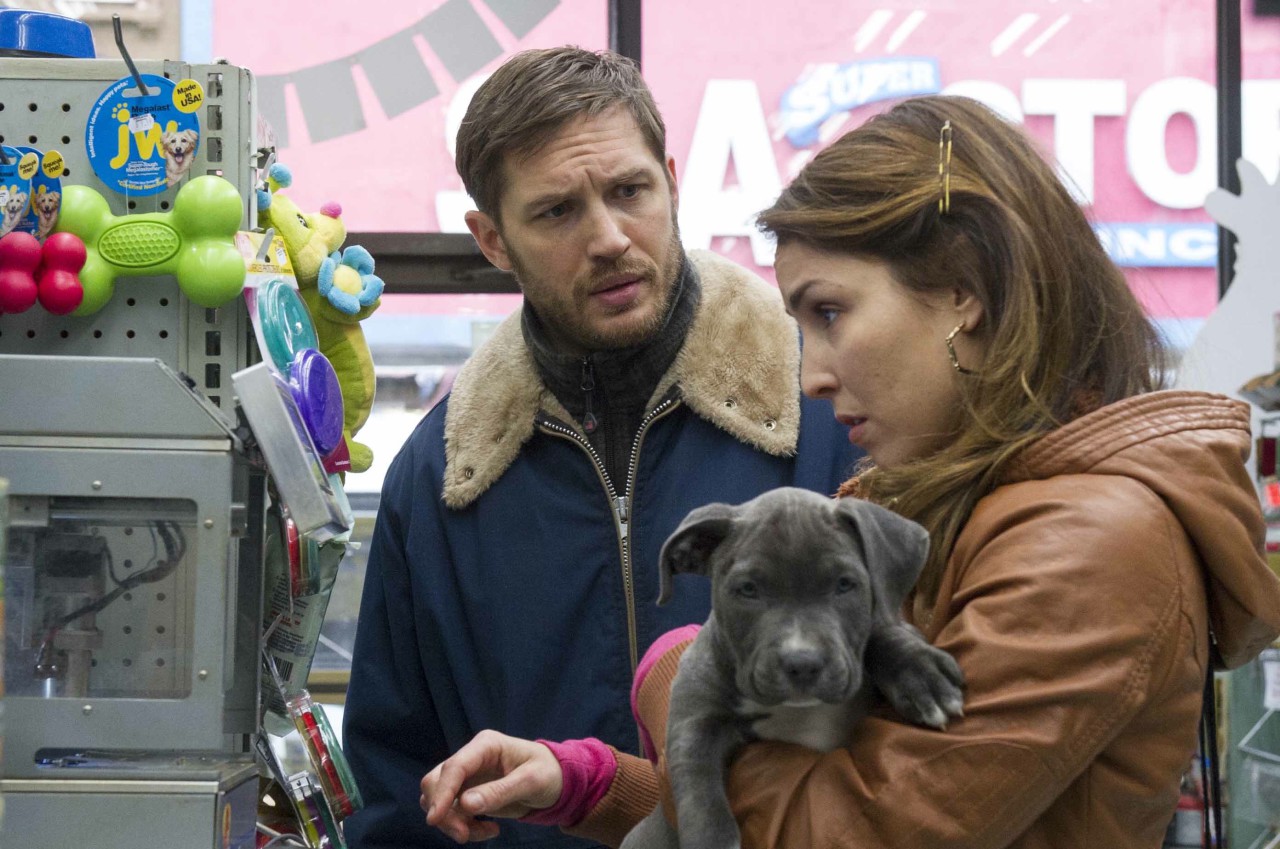
The story is unfolded in three narrative threads: There are Bob (Tom Hardy) and his cousin Marv (James Gandolfini) who run a bar belonging to the Chechen mob. When, one night, the bar is robbed by two masked men, Bob and Marv are under pressure to retrieve the money. Then there’s Nadia (Noomi Rapace) in whose waste bin Bob finds a hurt pit bull puppy. Nadia and Bob befriend each other while taking care of the dog, and soon find themselves up against Eric Deeds (Matthias Schoenaerts), a known psychopath and owner of the puppy he now wants back. And, finally, there’s Detective Torres (John Ortiz) who investigates not only the bar robbery but also the disappearance of a young man who is said to have been murdered by Deeds almost ten years ago.

The outline seems to indicate that we’re directly headed into 106 minutes of full-on mobster bloodshed and insanity. However, actual violence is not at the centre of The Drop. There are, of course, moments of brutality – but they’re short and only mildly graphic. Roskam’s film relies much more on character development and a thick, intense atmosphere – and this is where the genre mix takes its full effect. Setting Bob’s sweet, blossoming relationship with Nadia and his growing affection for the little puppy up against his Chechen trouble and the sadistic Eric Deeds causes a fair amount of unease. People who have the tendency to fear for the pet whenever they watch a horror movie or thriller – like me – will probably remain on the edge of their seats throughout most of the film. But even without the cute puppy in distress at the centre of things, The Drop succeeds in portraying how sweetness and decency are corrupted in a world ruled by power struggles, revenge and sheer madness.

For me, Bob certainly is one of the most intriguing cinematic characters in recent years, and Tom Hardy plays him to perfection. As the butt of the film’s inherent dog metaphor, Bob functions as the human counterpart to the little combat dog: he’s sweet-natured, open-minded, unassuming and protective of the ones he holds dear. And yet there’s something unsettling about him when we see how naturally he navigates through the challenges his crime-ridden neighbourhood throws at him, how easy it is for him to adapt to his surroundings. Hardy gives the character quirky features without ridiculing him, an innate strength without turning him into an alpha male and a sadness without having him appear whiney. His Bob is an intriguing, subtle take on the lonesome noir hero figure.

The film features a splendid cast in general. Noomi Rapace delivers a heartfelt performance as a woman who has pulled herself out of emotional misery, and has wonderful chemistry with Hardy. The late James Gandolfini, in his final performance, plays his established ruthless gangster role, but his present discontent and longing for better days gone by give him a human twist. Matthias Schoenaerts certainly is an actor to look out for. He gives Eric a good amount of unpredictability and makes him instantly menacing. John Ortiz as the persistent cop is solid, even though his plot appears a bit like mere filler material until things come full circle in the finale.

Those who are familiar with Lehane’s oeuvre know that the writer enjoys a good twist. The Drop also succeeds in connecting all the loose threads to a rather unexpected revelation. If I would have to come up with some kind of beef I could have with the film, though, it’s probably that things aren’t as effective on a second viewing. The moment I knew when and in what way tensions were going to relieve themselves, the atmosphere was no longer as haunting as it was during my first viewing experience and, naturally, the twist no longer comes unexpectedly.

Still, it pays off to (re)visit The Drop since it’s not only about plot development or grand twists at the end. The film presents us with thoroughly written and acted characters, and it’s fun to see them form and deconstruct their mutual relationships. Additionally, there’s an intriguing layer of social criticism as well as an exciting exploration of human nature. Throw in an unconventional yet fitting mix of generic tones and a cute puppy, and you’re certain to have created a crime drama that definitely shouldn’t be dropped.


Rating: